
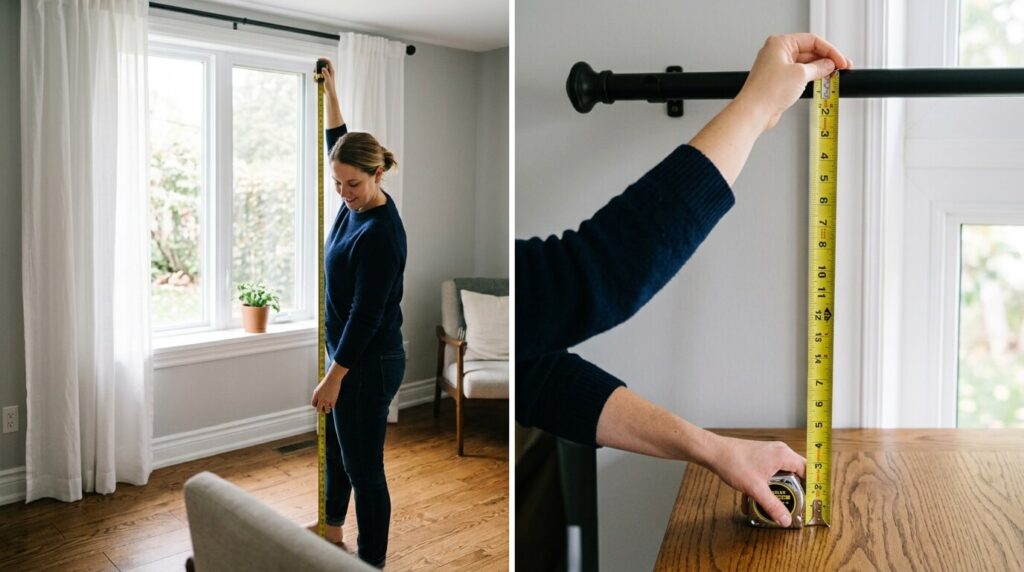
Choosing beautiful curtains is only half the job. The real challenge is getting the measurements right. Curtains that are too short can make a room look unfinished, while panels that are too wide or narrow may not hang properly.
The good news? Measuring for curtains is much easier than it sounds. With a tape measure, a pencil, and a few minutes of careful planning, you can get accurate dimensions and order curtains with confidence. Think of measuring your windows like taking a tailor’s measurements before making a suit—the better the measurements, the better the final fit.
This guide explains how to measure for curtains from start to finish, including window width, drop, curtain poles, tracks, fullness, different hanging styles, and common mistakes to avoid.
What You Need Before Measuring
Before you start, gather a few basic items. You don’t need specialist equipment, but having the right tools can make the process much easier.
You will need:
- A metal tape measure: A flexible sewing tape can work, but a firm metal tape is usually easier for measuring larger windows.
- A pencil and paper: Write down every measurement immediately.
- A calculator: Useful when calculating curtain fullness.
- A step ladder: If the window or pole is high, make sure the ladder is stable.
- A second person: This can be helpful when measuring wide windows or high curtain positions.
Measure each window separately, even if two windows appear identical. Small differences can occur between windows, particularly in older homes.
Always record measurements in the same unit. If you are ordering curtains in centimetres, keep all your calculations in centimetres rather than switching between centimetres and inches.
Decide Where the Curtains Will Hang
Before putting the tape measure against the window, decide where you want the curtains to sit.
Will they hang inside the window recess, or will the curtain pole or track be installed outside it?
This decision affects your measurements.
Inside the recess:
The curtain sits within the window opening. This can create a neat, compact appearance, but it leaves less room for the fabric to cover the window.
Outside the recess:
The pole or track extends beyond the window. This is a popular option because the curtains can cover more of the wall and stack beside the glass when opened.
For many rooms, positioning the curtain hardware slightly above and beyond the window can make the window appear larger and allow more natural light into the room when the curtains are open.
Before measuring, check for obstacles such as radiators, handles, furniture, shelves, or window frames. You want the finished curtains to operate comfortably without getting caught on anything.
How to Measure the Curtain Width
Width is one of the most important measurements because curtains need enough fabric to create attractive folds.
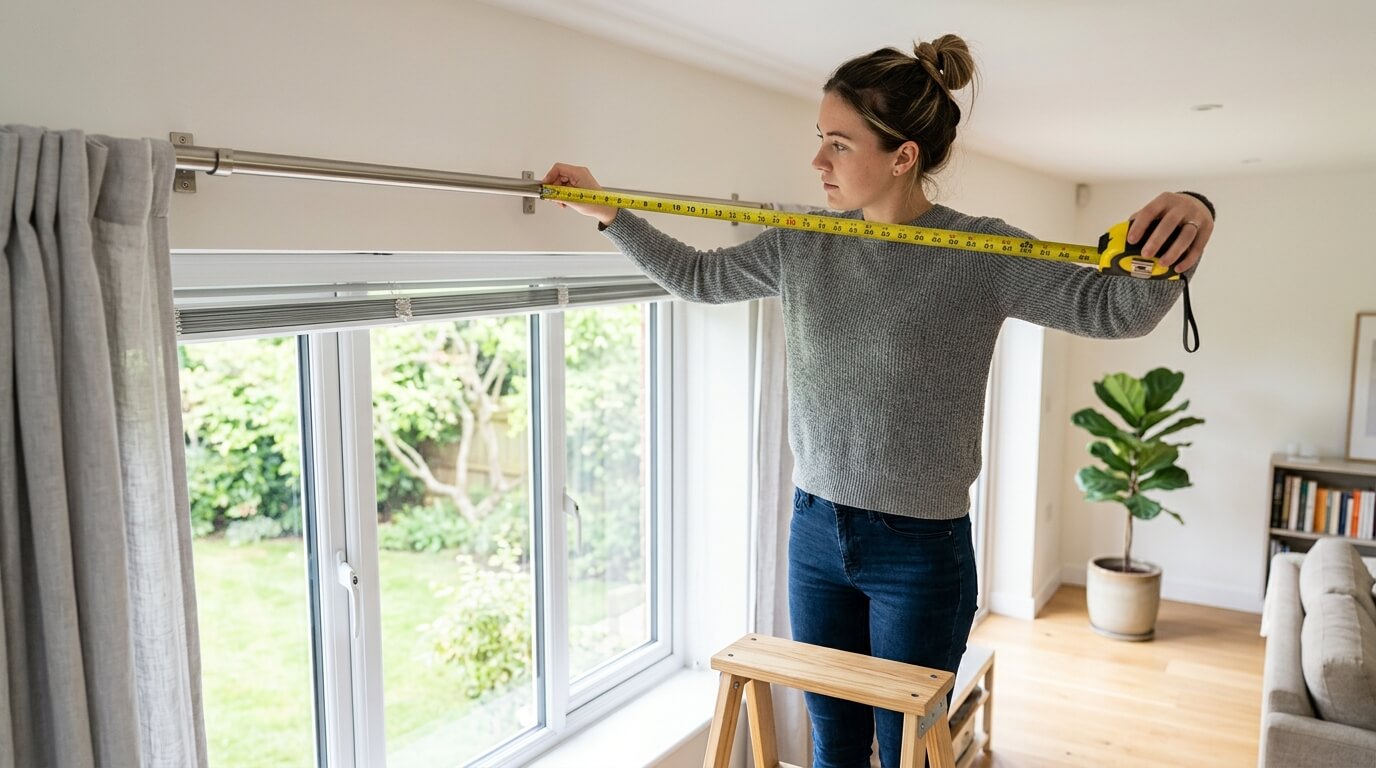
Step 1: Measure the area the curtains need to cover.
If you already have a curtain pole, measure the pole rather than the window itself. Usually, you should measure the pole from one end to the other, excluding decorative finials if appropriate.
If you are installing a new pole, measure the window and decide how far the pole should extend on each side.
For example, imagine your window is 150 cm wide. You might decide that the pole should extend 20 cm beyond each side. Your curtain coverage width would then be:
150 cm + 20 cm + 20 cm = 190 cm
That 190 cm becomes the basis for your curtain width calculation.
Don’t simply order a curtain that is exactly the same width as the window. Fabric needs extra width to form pleats and folds.
How to Measure Curtain Drop or Length
The drop is the vertical measurement from the point where the curtain will hang to the desired finishing point.
The correct starting point depends on your curtain hardware and heading style.
For a curtain pole, measure from the top or appropriate hanging point of the pole down to where you want the curtain to finish.
For a curtain track, measure from the top of the track or the relevant glider position.
Measure the drop in at least two or three places. Floors, ceilings, and window openings are not always perfectly level. If your measurements differ slightly, consider the position and style of the curtains before choosing the final figure.
There are several popular finishing options.
Sill-Length Curtains
These curtains finish around the windowsill. They are useful for smaller windows and rooms where long curtains might interfere with furniture or heating.
Below-Sill Curtains
These extend slightly below the sill and offer more coverage without reaching the floor.
Floor-Length Curtains
Floor-length curtains create a classic appearance. They generally finish just above the floor or gently meet it, depending on the desired style.
Pooling Curtains
Some people prefer extra fabric that rests softly on the floor. This creates a luxurious look but requires more fabric and may require additional cleaning.
Choose the finishing style before taking your final drop measurement.
Measuring for a Curtain Pole
If you are fitting a new pole, measure the window first and then decide how much additional width you want on either side.
A common approach is to extend the pole beyond both sides of the window so that the curtains can move away from the glass when opened.
Measure these three areas:
- Window width
- Extra space on the left
- Extra space on the right
Add them together to determine the pole length.
For example:
- Window width: 160 cm
- Left extension: 20 cm
- Right extension: 20 cm
- Recommended coverage: 200 cm
Remember that the exact extension depends on the room, available wall space, furniture, and curtain style.
Check the manufacturer’s instructions before purchasing a pole. Very wide curtains may require additional support brackets.
Measuring for a Curtain Track
Curtain tracks are measured in a similar way to poles, but the fitting itself may have different requirements.
If the track is already installed, measure the track width rather than the window.
If you’re installing a new track, decide how much wall coverage you need before measuring.
Tracks can be particularly useful for large windows, bay windows, and rooms where a minimal appearance is preferred.
For bay windows, measure each section carefully. Don’t assume that every side of the bay is the same length.
Also check whether the curtains need to meet in the middle, open from one side, or operate independently. This can affect how the curtain panels are divided.
How Much Curtain Fullness Do You Need?
One of the most common mistakes is confusing the curtain’s finished width with the width of the window.
Curtain fabric needs additional width to create folds. This is known as fullness.
A simple calculation is:
Curtain fabric width = pole or track width × fullness ratio
A fullness ratio of around 1.5 to 2 times the track or pole width is often suitable, depending on the curtain heading and desired appearance.
For example, if the pole is 200 cm wide and you choose a 2× fullness:
200 × 2 = 400 cm
You would therefore need approximately 400 cm of total curtain width.
The exact amount can vary according to the heading style and manufacturer’s recommendations.
Ready-made curtains are usually sold by finished panel dimensions, so check whether the stated width refers to one curtain panel or the complete pair.
This is especially important when shopping online. A package described as “width 140 cm” might contain one 140 cm-wide panel or two panels totaling 140 cm, depending on the manufacturer.
Measuring Different Curtain Styles
Different headings can require slightly different measuring approaches.
Pencil pleat curtains use gathered fabric and can offer considerable flexibility because the curtain tape can be adjusted.
Pinch pleat curtains have structured folds, so the finished width and fullness need to be considered carefully.
Wave curtains use a track system and require accurate track measurements because the wave pattern depends on the spacing of the gliders.
Rod pocket curtains slide directly over the pole, so the pole diameter and pocket size need to be checked.
Tab-top curtains hang from fabric loops. Their finished appearance can be influenced by the size and spacing of the tabs.
Always check the curtain manufacturer’s measurement instructions before ordering a specific style.
How to Measure for Eyelet Curtains
Eyelet curtains have metal rings built into the top of the fabric. They are simple to install but need slightly different consideration.
Measure from the top of the curtain pole to your chosen finishing point.
Do not automatically measure from the ceiling or from the top of the window unless that is where the pole will be installed.
The pole should be narrow enough to pass through the eyelets comfortably, but sturdy enough to support the curtain’s weight.
Pay attention to the top of the curtain. Eyelet curtains naturally create larger, regular folds, and the position of the first and last eyelet affects how much fabric extends beyond the pole.
When buying ready-made eyelet curtains, compare your required drop with the manufacturer’s stated drop.
Measuring for Curtains with a Lining
Lined curtains can provide extra insulation, privacy, light control, and a fuller appearance.
The important thing is that the lining should generally correspond to the curtain dimensions, rather than being measured independently as though it were another window covering.
If you’re buying ready-made lined curtains, use the manufacturer’s stated finished dimensions.
For made-to-measure curtains, provide accurate pole or track width and the required finished drop. The manufacturer or curtain maker can then calculate the necessary fabric and lining.
Blackout curtains require particular attention to coverage. If your goal is to reduce incoming light, gaps around the sides and top can allow sunlight to enter even when the curtain itself is opaque.
This is why an outside-mounted curtain can sometimes provide better light coverage than an inside-recess installation.
Common Curtain Measuring Mistakes
Even a small measurement mistake can result in curtains that don’t look or function as expected.
Here are some common problems to avoid.
Measuring Only the Glass
The glass area isn’t necessarily the same as the area your curtains need to cover. Measure the pole, track, recess, or intended installation area instead.
Forgetting Fullness
Ordering fabric equal to the window width can leave the curtains looking flat and stretched.
Mixing Units
Don’t record one measurement in inches and another in centimetres without converting them.
Measuring Once
Measure twice. It takes an extra minute but can prevent an expensive mistake.
Ignoring Obstacles
Radiators, door handles, furniture, and window handles can affect where curtains should hang.
Assuming All Windows Are Identical
Even windows in the same room can have slightly different dimensions.
Ordering Without Checking Panel Dimensions
Always check whether the advertised width represents one panel or a pair.
Forgetting the Curtain Heading
Eyelets, pleats, tabs, and tracks can all affect the required measurements.
A Simple Curtain Measuring Checklist
Before placing an order, go through your measurements one final time.
Your checklist should include:
- Window width
- Pole or track width
- Left and right extensions
- Required curtain drop
- Curtain heading style
- Desired fullness
- Number of panels
- Whether the curtains are lined
- Whether the curtains need to clear furniture or radiators
- Whether you want the curtains to finish at the sill, below the sill, or at the floor
Write everything down clearly.
For example:
Pole width: 200 cm
Required drop: 230 cm
Fullness: 2×
Curtain arrangement: Two panels
Finish: Floor length
This simple record can make ordering much less confusing.
How to Get the Best Results When Ordering Curtains
Once you have your measurements, compare them with the seller’s sizing information.
Don’t rely only on the product title. Look for the detailed size chart.
Check whether measurements are:
- Per panel or per pair
- Finished dimensions or fabric dimensions
- Given in centimetres or inches
- Measured from the top of the heading
- Suitable for your particular pole or track
If you’re ordering made-to-measure curtains, provide the exact measurements requested by the supplier rather than guessing the amount of fabric required yourself.
For unusual windows, such as bay windows, very tall windows, or unusually wide openings, professional measuring can be worthwhile.
Remember: accurate measurements are the foundation of a good-looking window treatment. Beautiful fabric cannot compensate for incorrect dimensions.
Conclusion
Learning how to measure for curtains doesn’t have to be complicated. Start by deciding where the curtains will hang, measure the pole or track area carefully, calculate the required fullness, and then determine the correct drop. Always measure more than once and check whether a product’s listed width applies to one panel or a pair.
Take your time and treat the measuring process like creating a blueprint for your curtains. A few careful measurements now can save you from costly alterations or returns later.
Frequently Asked Questions
1. Should I measure the window or the curtain pole?
If a curtain pole is already installed, generally measure the pole or track rather than simply measuring the glass. If you’re installing new hardware, calculate the desired pole or track width based on the window and available wall space.
2. How much wider should curtains be than the window?
Curtains normally need additional fabric to create folds. The amount depends on the heading and desired fullness, but a common approach is around 1.5 to 2 times the coverage width.
3. Should curtains touch the floor?
They can finish just above the floor, touch it lightly, or extend slightly onto it. The best choice depends on your preferred appearance, cleaning needs, and room layout.
4. Do I measure each window separately?
Yes. Even windows that look identical can have small differences. Measuring each one individually helps ensure a better fit.
5. What is the biggest mistake when measuring curtains?
One of the biggest mistakes is measuring only the window width and forgetting the curtain pole or track, fullness, heading style, and desired drop. Always consider the complete installation rather than the glass alone.