
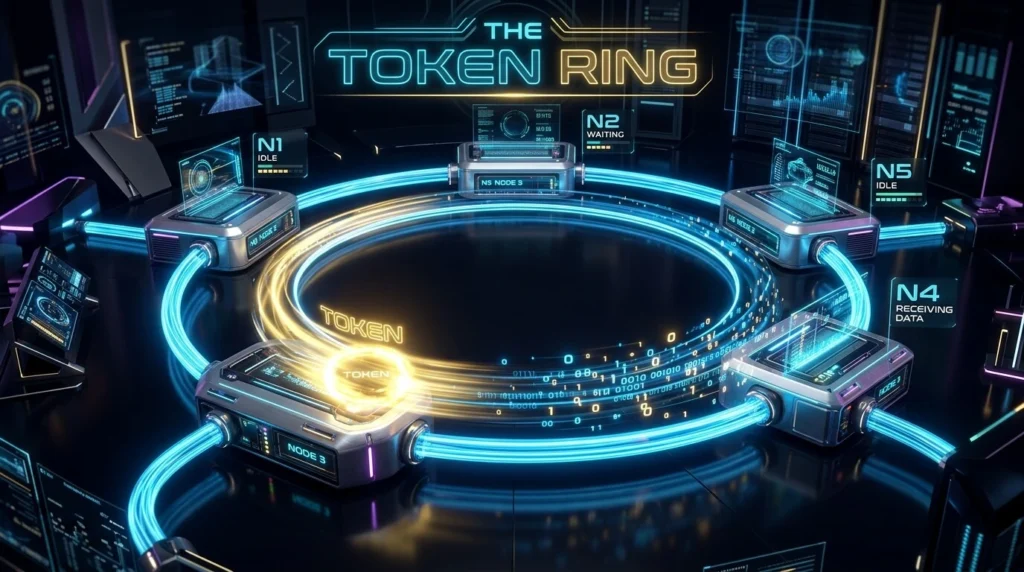
Picture a meeting where only the person holding a small ball is allowed to speak. When they finish, they pass the ball on. Nobody talks over anyone, and everybody gets a turn.
That is the core idea behind one of the most influential networking technologies of the 1980s and 1990s. If you have ever asked yourself “what is a token ring?”, you are in the right place. Below you will learn how it works, why big companies trusted it, how it compares with Ethernet, and why you rarely see it today.
What Is a Token Ring?
A token ring is a local area network (LAN) technology in which computers take turns sending data by passing a special signal, called a token, around a logical ring. Only the device holding the token may transmit. This prevents data collisions and gives every device a fair chance to communicate.
IBM developed the technology in the 1980s, and it was later standardised as IEEE 802.5. For years, banks, insurers, airlines, and large corporations ran their internal networks on it, mainly because it behaved so predictably.
In short, a token ring network is a token passing network: a device speaks only when it holds the token.
How a Token Ring Network Works
The logic is simple once you see the pieces.
What Is the Token?
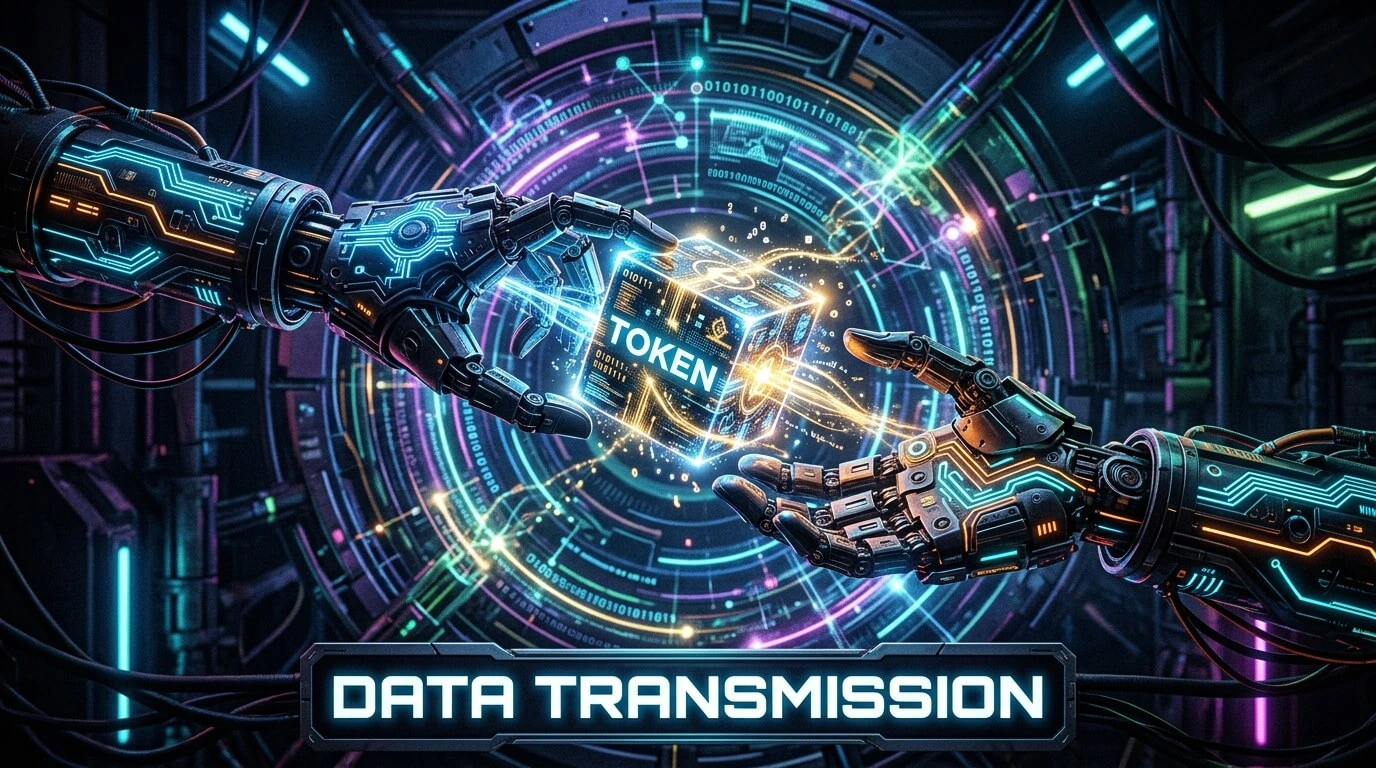
The token is a tiny data frame, just three bytes long, that circulates continuously when the network is idle. It works like a permission slip. If a computer wants to send something, it waits for the token to arrive.
Sending Data Step by Step
Here is what happens when one computer wants to send a file to another:
- The sending computer waits until a free token reaches it.
- It grabs the token, attaches its data along with the destination address, and sends the frame onward.
- Each computer on the ring passes the frame along, checking whether the address is its own.
- The destination computer copies the data and marks the frame as received.
- The frame keeps travelling until it returns to the sender, who removes it and releases a fresh token.
Because only one device can transmit at a time, collisions cannot happen. That was a real selling point in the early days of networking.
The Role of the Active Monitor
One computer on the ring is elected as the active monitor. Think of it as the referee. It watches for lost tokens, endless looping frames, and other faults, and it keeps the ring’s timing steady. If the monitor fails, the other devices automatically choose a new one. When a serious fault occurs, stations use a process called beaconing to report where the break is, which helps administrators find the problem quickly.
Token Ring Topology: Physical Star, Logical Ring
The name suggests a literal circle of cable, but that is not how most token ring networks were built.
Physically, computers connected to a central device called a Multistation Access Unit (MAU), so the wiring looked like a star. Inside the MAU, the connections were arranged so that data still moved from one station to the next in a loop. That is why experts describe token ring topology as a physical star and logical ring.
This design solved a nasty problem. In a true ring, one broken cable or switched-off computer could stop the whole network. The MAU could bypass a faulty or disconnected station automatically, so the ring stayed alive. Early installations often used shielded twisted-pair cable, and later versions supported ordinary unshielded twisted-pair.
Token Ring Speeds and Frame Types (IEEE 802.5)
The original token ring specification ran at 4 Mbps. IBM later introduced a 16 Mbps version, which used a technique called early token release to send the token sooner and use the bandwidth more efficiently. Standards for 100 Mbps and even 1 Gbps were eventually written, but almost no one deployed them.
Token ring also supported a priority system. Special bits in the frame let urgent traffic reserve the next available token, so time-sensitive data could jump ahead of routine transfers. This made the network’s behaviour very predictable, which engineers call being “deterministic.”
Token Ring vs Ethernet: What Was the Difference?
Both connected office computers, but they handled traffic in opposite ways.
| Feature | Token Ring | Ethernet |
|---|---|---|
| Access method | Token passing | CSMA/CD (listen, then send) |
| Collisions | None in normal operation | Possible on shared media |
| Performance under heavy load | Stable and predictable | Could slow down on busy shared networks |
| Typical speeds (classic era) | 4 and 16 Mbps | 10 Mbps, then 100 Mbps and beyond |
| Hardware cost | Higher | Lower |
Early Ethernet let devices transmit whenever the line looked quiet, and if two sent at once, both had to try again. Token ring avoided that mess entirely. On paper, that made it the more orderly choice.
Advantages and Disadvantages of Token Ring
Advantages
- No collisions: only the token holder transmits.
- Fair access: every station gets a turn, even during heavy traffic.
- Predictable performance: useful for systems that needed consistent response times.
- Built-in fault management: the active monitor and MAU improved reliability.
Disadvantages
- Expensive equipment: adapters, MAUs, and cabling cost more than Ethernet gear.
- Limited speed growth: 16 Mbps stayed the practical ceiling for too long.
- Complex management: token recovery and ring maintenance needed skilled staff.
- Narrow vendor ecosystem: it was tied closely to IBM and a small group of suppliers.
Why Did Token Ring Disappear?
If token ring was so well organised, why did it fade away?
The answer is mostly economics. Ethernet hardware kept getting cheaper and faster. Then came switched Ethernet, where each device gets its own dedicated connection to a switch. That removed the collision problem that had been Ethernet’s main weakness. Suddenly, token ring’s biggest advantage no longer mattered, while its higher price and slower speeds still did.
By the late 1990s and early 2000s, most organisations were migrating to Ethernet. Today token ring survives only in a few legacy environments, some old industrial systems, and networking textbooks. The token passing idea itself lives on, though. Technologies such as FDDI used it, and it still shapes how engineers think about fair access to shared resources.
Is Token Ring Still Used Today?
Very rarely. You may still find it inside older enterprise systems that have never been upgraded, but new installations essentially do not exist. Hardware is hard to source, and modern operating systems no longer support the necessary adapters. If you meet a token ring network in the wild, treat it as a migration project rather than something to expand.
Frequently Asked Questions
What is a token ring in simple words?
A token ring is an older type of computer network where devices take turns sending data by passing a small digital “permission slip” called a token. Only the device holding it can transmit.
What is the difference between token ring and Ethernet?
Token ring uses token passing to avoid collisions, while traditional Ethernet lets devices send whenever the line seems free and handles collisions after they happen. Modern switched Ethernet has largely removed that problem and is faster and cheaper.
What standard does token ring follow?
Token ring is defined by the IEEE 802.5 standard, which covers how the token, frames, and ring operate.
Is token ring a physical ring?
Usually not. Most networks used a star layout with a central MAU, while data still travelled in a logical ring.
Why is token ring obsolete?
Ethernet became faster, cheaper, and easier to manage. Once switches solved Ethernet’s collision issues, token ring had little left to offer.
Conclusion
So, what is a token ring? It is a smart, orderly LAN technology that gave every computer a fair turn to speak by passing a token around a logical ring. It was reliable and predictable, but ultimately lost out to cheaper, faster Ethernet.
Understanding it still pays off. It explains why modern networks are built the way they are and gives you a solid grounding in core networking concepts.
Want to go deeper? Explore how Ethernet, switches, and Wi-Fi work next, and share this guide with a colleague or student who is starting out in networking. If you have hands-on experience with token ring, leave a comment and tell us how it went.