

You reach behind you to grab your seatbelt and feel a sharp twinge at the back of your shoulder. Or you finish a heavy set of rows and notice a deep ache near your armpit that won’t go away. Most people blame the rotator cuff or the lats. Very often the real culprit is a small muscle nobody talks about: the teres major.
It’s a small muscle, but it’s involved in almost every pulling, reaching and throwing movement you make. In this guide, you’ll learn where the teres major sits, what it does, why it gets sore, and how to train, stretch and look after it, with simple steps you can start using this week.
What Is the Teres Major Muscle?
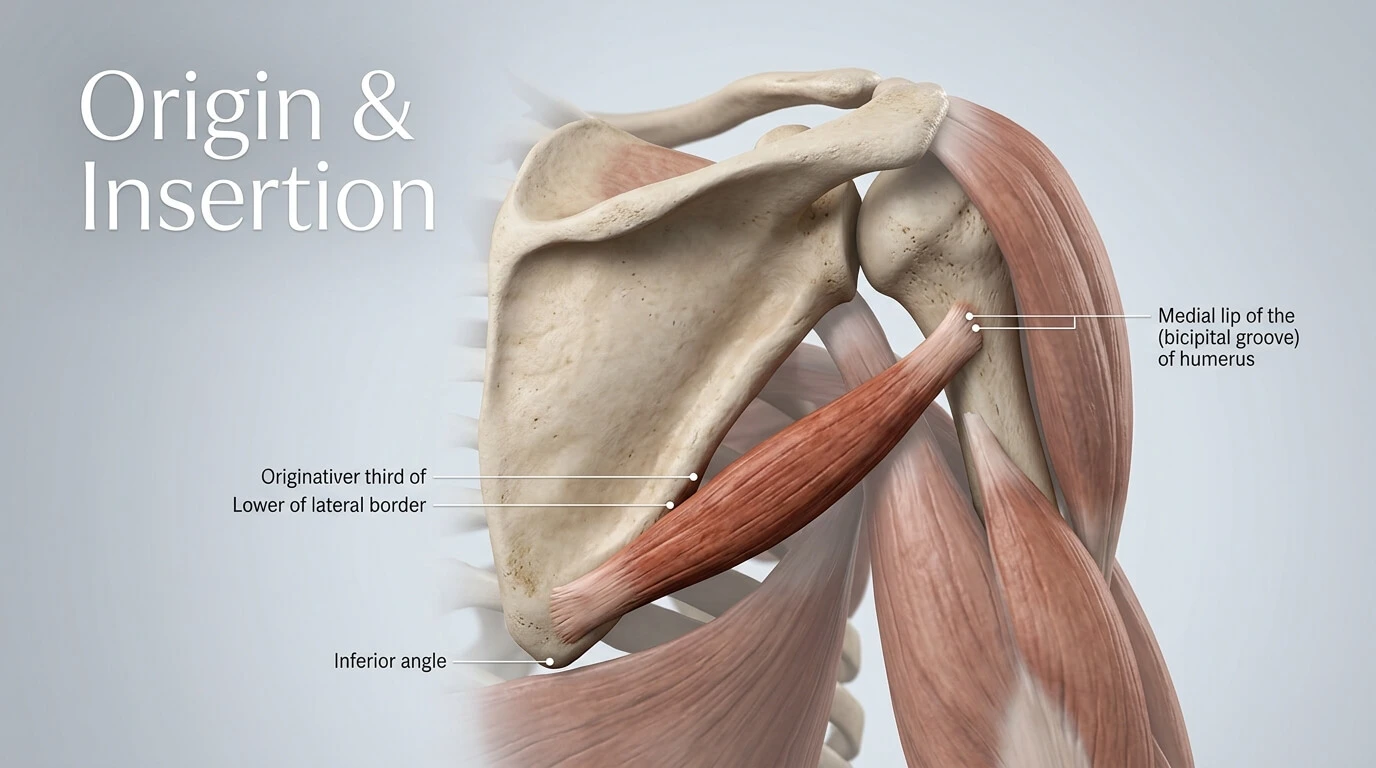
The teres major is a thick, rounded muscle on the back of the shoulder. It runs from the lower edge of the shoulder blade to the upper arm bone and helps pull the arm down and back, and rotate it inward.
Gym-goers and physiotherapists often call it “the lat’s little helper.” It runs right alongside the latissimus dorsi, and the two work as a team. Together they form the back wall of your armpit, which is why you can feel the teres major as a firm ridge there if you squeeze the back of your armpit while pulling your arm down.
People often mix it up with the teres minor. That’s a different, smaller muscle that sits higher up and belongs to the rotator cuff. The teres major isn’t part of the rotator cuff, although it works right beside it.
Teres Major Anatomy: Origin, Insertion and Nerve Supply
Here’s the quick version:
- Origin: the lower outer edge of the shoulder blade (scapula)
- Insertion: the front of the upper arm bone (humerus), close to the latissimus dorsi tendon
- Nerve supply: the lower subscapular nerve
- Blood supply: mainly the circumflex scapular artery
You don’t need to memorise this. What matters is that the muscle pulls the arm bone toward the shoulder blade, and that’s what drives its main actions.
What Does the Teres Major Do?
The teres major has three main jobs: it extends the arm (moves it backward), adducts it (brings it toward your body) and rotates it inward.
Everyday Movements That Use the Teres Major
You use this muscle far more than you’d think:
- Pulling a heavy door toward you
- Reaching behind you for a bag or a seatbelt
- Tucking in a shirt at the back
- Swimming strokes, rowing and climbing
- Throwing and racket swings
Why It Matters for Shoulder Stability
The teres major also helps hold the head of the arm bone steady in the shoulder socket while you move. When it’s weak or tight, other muscles around the shoulder have to work harder, and that’s when niggles start to appear.
Teres Major Pain and Strain: Signs to Watch For
A strained teres major usually shows up as pain in the back of the shoulder or upper back, sometimes reaching toward the armpit or the back of the upper arm. It often feels worse when you pull, reach overhead or rotate your arm inward.
Common triggers include:
- Jumping into heavy pull-ups, rows or pulldowns without warming up
- Repeating the same overhead or pulling motion, as in swimming, rowing, climbing or baseball
- Sudden jerks, such as catching a heavy object
- Poor posture that keeps the shoulder rounded for hours
Mild strains often settle with sensible rest and gradual loading, but the pain can drag on if you keep pushing through it.
When to see a professional: get it checked if you have numbness, tingling, noticeable weakness, pain at night that doesn’t ease, or a sudden pop with bruising. Shoulder pain can sometimes come from elsewhere in the body, so if it comes with chest tightness or shortness of breath, seek urgent medical help. A physiotherapist or doctor can give you a proper diagnosis.

Best Teres Major Exercises
The good news is that you don’t need special equipment. The teres major works hard in most pulling exercises, especially those where your arm moves from overhead down toward your hips. Here are five reliable options, with a starting point for sets and reps.
- Lat pulldown (3 sets of 8-12): Pull the bar to your upper chest and drive your elbows down toward your hips.
- Seated cable row (3 sets of 10-12): Keep your chest tall and squeeze your shoulder blades back and down.
- One-arm dumbbell row (3 sets of 10 per side): Pull your elbow toward your hip, not straight up to the ceiling.
- Straight-arm pulldown (3 sets of 12-15): With arms nearly straight, sweep the handle down to your thighs. This one feels great on the back of the armpit.
- Assisted pull-up (3 sets of 5-8): A good stepping stone if full pull-ups are still out of reach.
Form Tips That Make a Real Difference
- Start each rep by setting your shoulder blade, not by yanking with your hand.
- Slow the lowering phase to about three seconds.
- Keep your shoulders away from your ears.
- Add weight gradually. If you feel sharp pain, stop.
A Simple Warm-Up
Spend three to five minutes on arm circles, band pull-aparts and a few light pulldowns before you go heavy. Cold muscles strain much more easily.
Teres Major Stretches for Flexibility and Relief
A tight teres major can limit how far you can lift your arm overhead. Try these after training, holding each for 20 to 30 seconds and repeating two or three times:
- Overhead reach stretch: Raise one arm overhead, bend the elbow, and gently lean to the opposite side until you feel a stretch along the back of your armpit.
- Child’s pose with side reach: Kneel, sit back on your heels, stretch both arms forward, then walk your hands toward one side.
- Doorway stretch: Place your forearm on a door frame at about head height and turn your body away slowly.
Stretch to a mild pull, never to pain.
How to Recover From a Teres Major Strain
If you think you’ve strained the teres major, keep the plan simple:
- Ease off the movements that hurt, but keep gently moving the shoulder within comfort.
- Use heat or ice, whichever eases the pain for you.
- Restart gradually with light bands or very low weights once daily movements feel normal.
- Build back slowly over several weeks rather than jumping back to your old numbers.
Mild strains often improve within a few weeks, while more serious ones take longer. If progress stalls, a physiotherapist can build a plan around your sport and job.
Frequently Asked Questions About the Teres Major
Where is the teres major located?
It sits on the back of the shoulder, running from the lower outer edge of the shoulder blade to the upper arm bone, just below the teres minor.
Is the teres major part of the rotator cuff?
No. The rotator cuff is made up of the supraspinatus, infraspinatus, teres minor and subscapularis. The teres major works nearby but isn’t included.
Can you pull or strain the teres major?
Yes. It’s most common in swimmers, rowers, climbers, throwers and lifters, usually after sudden or repeated pulling.
How long does a teres major strain take to heal?
Mild strains often settle in a few weeks, but severity and how well you manage the load both matter. A professional can give you a personal timeline.
What is the best exercise for the teres major?
Lat pulldowns and rows are excellent starting points because they train the muscle through its natural pulling path.
Final Thoughts: Give Your Teres Major the Attention It Deserves
The teres major may be small, but it helps power every pull, reach and throw. Now you know where it sits, what it does, how to spot a problem and which exercises and stretches keep it working well.
Your next step: pick two exercises and one stretch from this guide and add them to your next workout. If you’re dealing with ongoing shoulder pain, book a visit with a physiotherapist before pushing on. Found this useful? Share it with a training partner, and check out our other shoulder and back guides.