
How Many Weeks in a Year? A Complete Guide
Have you ever looked at a calendar and wondered, how many weeks in a year? It seems like a simple question, but the answer is more interesting than many people realize. Most people say a year has 52 weeks, and while that’s generally correct, there’s a little more to the story.
Understanding how weeks fit into a year can help with work planning, school schedules, budgeting, fitness goals, and even vacation planning. Think of a year as a large puzzle, while each week is one of the pieces. When you understand how those pieces fit together, organizing your life becomes much easier.
In this guide, we’ll explain everything in simple language so anyone can understand.
1. What Is a Week?
A week is a period of seven consecutive days. The days are:
- Monday
- Tuesday
- Wednesday
- Thursday
- Friday
- Saturday
- Sunday
The seven-day week has been used for thousands of years and is recognized worldwide. It provides a convenient way to organize work, education, travel, and daily life.
2. How Many Weeks Are in a Year?
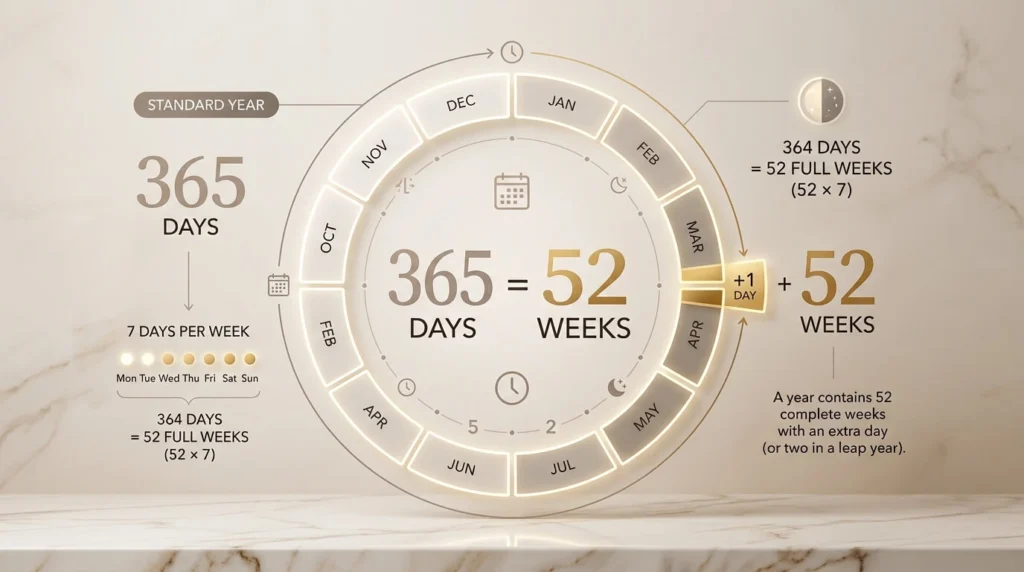
A standard year has:
- 365 days
- 52 full weeks
- 1 extra day
Since:
52 × 7 = 364 days
There is always one additional day left over.
Therefore:
365 ÷ 7 = 52 weeks and 1 day
So the common answer is:
There are 52 weeks in a year, plus one extra day.
3. Why Isn’t the Answer Exactly 52 Weeks?
Many people assume a year contains exactly 52 weeks, but mathematics tells a different story.
Because a standard year has 365 days, and weeks consist of 7 days, the division leaves one extra day.
Imagine cutting a pizza into seven equal slices. If you have enough pizza for 52 complete sets of slices plus one additional slice, you don’t quite have another complete set.
That’s exactly how the calendar works.
4. Leap Years Explained
Every four years, an extra day is added to the calendar.
This creates a leap year, which contains:
- 366 days
- 52 weeks and 2 days
The extra day is added to February, giving it 29 days instead of 28.
Leap years help keep our calendar aligned with Earth’s journey around the Sun.
Without leap years, seasons would gradually shift over time.

5. What Is a 53-Week Year?
Sometimes people hear about a 53-week year.
This usually happens because of the way calendars count weeks.
Certain business calendars, payroll systems, and the ISO week-numbering system occasionally include 53 numbered weeks.
This does not mean the year suddenly becomes much longer.
Instead, the extra days at the beginning or end of the year create an additional calendar week.
6. Weeks in Different Calendar Systems
Different organizations count weeks differently.
Standard Calendar
- 365 days
- 52 weeks + 1 day
Leap Year Calendar
- 366 days
- 52 weeks + 2 days
ISO Week Calendar
The ISO standard is commonly used in Europe and international business.
In this system:
- Most years have 52 weeks.
- Some years have 53 numbered weeks.
This helps businesses maintain consistent scheduling.
7. Why Knowing Weeks Matters
Understanding the number of weeks in a year is useful in everyday life.
Work Planning
Companies schedule projects using weekly milestones.
Education
Schools organize semesters and examinations by weeks.
Fitness
Many workout programs last:
- 8 weeks
- 12 weeks
- 16 weeks
Knowing the annual number of weeks helps measure long-term progress.
Budgeting
Weekly savings become easier to calculate.
For example:
Saving $20 every week for 52 weeks equals:
$1,040
Small weekly habits produce significant yearly results.
8. Weeks Compared With Months
Months don’t contain the same number of weeks.
For example:
| Month | Days | Approximate Weeks |
|---|---|---|
| January | 31 | 4.4 |
| February | 28/29 | 4 |
| March | 31 | 4.4 |
| April | 30 | 4.3 |
| May | 31 | 4.4 |
| June | 30 | 4.3 |
| July | 31 | 4.4 |
| August | 31 | 4.4 |
| September | 30 | 4.3 |
| October | 31 | 4.4 |
| November | 30 | 4.3 |
| December | 31 | 4.4 |
This is why months don’t begin on the same weekday every year.
9. Fun Facts About Weeks and Years
Here are some interesting facts:
- A normal year has 365 days.
- A leap year has 366 days.
- Every week contains exactly 168 hours.
- Most years contain 52 complete weeks.
- Some calendar systems recognize 53 numbered weeks.
- There are 8,760 hours in a normal year.
- There are 525,600 minutes in a standard year.
These numbers are useful for science, education, and planning.

10. Common Misunderstandings
Many myths surround calendar calculations.
Myth 1: Every year has exactly 52 weeks
Not entirely.
A year has:
- 52 weeks
- plus one or two extra days
Myth 2: Leap years have 53 weeks
No.
Leap years have:
- 52 weeks
- plus two additional days
Only specific calendar systems may label them as having Week 53.
Myth 3: Every month has four weeks
Not true.
Most months have more than four weeks because they contain 30 or 31 days.
11. Practical Uses of Weekly Planning
Weekly planning makes life much more manageable.
Personal Goals
Instead of saying:
“I’ll exercise this year.”
Say:
“I’ll exercise three times every week.”
That creates a measurable goal.
Financial Planning
Weekly budgets prevent overspending.
Business
Companies often review:
- Sales
- Marketing
- Inventory
- Customer service
every week.
Students
Breaking study schedules into weekly targets reduces stress before exams.
Small weekly improvements lead to remarkable yearly achievements.
12. Final Thoughts
The answer to how many weeks in a year is straightforward yet surprisingly interesting. A standard year contains 52 weeks and one extra day, while a leap year contains 52 weeks and two extra days. Occasionally, certain calendar systems count 53 weeks, but this depends on the way weeks are numbered rather than the length of the year itself.
Whether you’re organizing work, tracking fitness, managing finances, or planning vacations, understanding the relationship between days, weeks, and years can make long-term planning much easier. Just like building a house one brick at a time, achieving big goals becomes more manageable when you focus on one week at a time.
Frequently Asked Questions (FAQs)
1. How many weeks are in a normal year?
A normal year contains 52 full weeks and 1 extra day, totaling 365 days.
2. How many weeks are in a leap year?
A leap year contains 52 weeks and 2 extra days, totaling 366 days.
3. Why do some calendars show 53 weeks?
Certain calendar systems, such as the ISO week calendar, occasionally number a year with 53 weeks because of how weeks align with the beginning and end of the year.
4. How many working weeks are in a year?
It depends on holidays and vacation time, but many full-time employees work approximately 48 to 50 weeks each year after accounting for leave.
5. Can every month be divided into exactly four weeks?
No. Most months have 30 or 31 days, making them slightly longer than four weeks. Only February in a common year has exactly four weeks (28 days).