
Preparing for a second term maths question paper can feel stressful, especially when several chapters, formulas, and different types of questions need to be revised. But mathematics becomes much easier when you know what to expect and practise in the right way.
A good question paper is like a road map: it shows students which skills they need to demonstrate and gives them an opportunity to check how well they understand the subject. Whether you are a student, parent, or teacher, understanding the structure of a second-term examination can make preparation more organised and effective.
1. What Is a Second Term Maths Question Paper?
A second-term mathematics examination usually evaluates the material students have studied during the latter part of an academic term or school year. The exact chapters and format depend on the class, school, board, and syllabus.
A typical paper may include several sections. Students might encounter multiple-choice questions, short-answer problems, longer calculations, geometry exercises, algebraic expressions, word problems, or questions requiring students to show their working.
The purpose is not simply to test whether you can remember a formula. Mathematics exams often check whether you can understand a problem, choose the correct method, perform calculations accurately, and explain your answer.
This is why simply reading solved examples is not enough. You need to put your pencil on paper and solve problems yourself.
2. Why Second Term Maths Preparation Matters
Maths is a subject where regular practice usually produces better results than last-minute memorisation. When you solve problems repeatedly, patterns become easier to recognise.
For example, after practising several equations, you may begin to identify which operation should be performed first without spending too much time thinking about it.
Good preparation can help you:
- Understand difficult concepts more clearly.
- Remember important formulas.
- Improve calculation speed.
- Reduce careless mistakes.
- Become more confident with unfamiliar questions.
- Manage examination time effectively.
- Identify weak areas before the actual test.
Think of preparation like building a staircase. Each solved question is another step, and eventually those small steps take you toward the confidence needed for the examination.
3. Understanding the Question Paper Pattern
Before starting serious revision, find out how your examination is organised. Look at previous papers, teacher-provided practice sheets, or the official syllabus where available.
Pay attention to:
Question types: Are there MCQs, fill-in-the-blanks, short questions, or detailed problems?
Marks: How many marks does each section carry?
Time: How long do you have to complete the paper?
Chapters: Which chapters are included?
Working: Are students expected to show complete calculations?
Understanding the pattern helps you avoid surprises. If most marks come from detailed questions, for example, spending all your revision time on multiple-choice questions would not be the best strategy.
However, remember that a practice paper is only a preparation tool. The actual examination may contain questions that are worded differently.
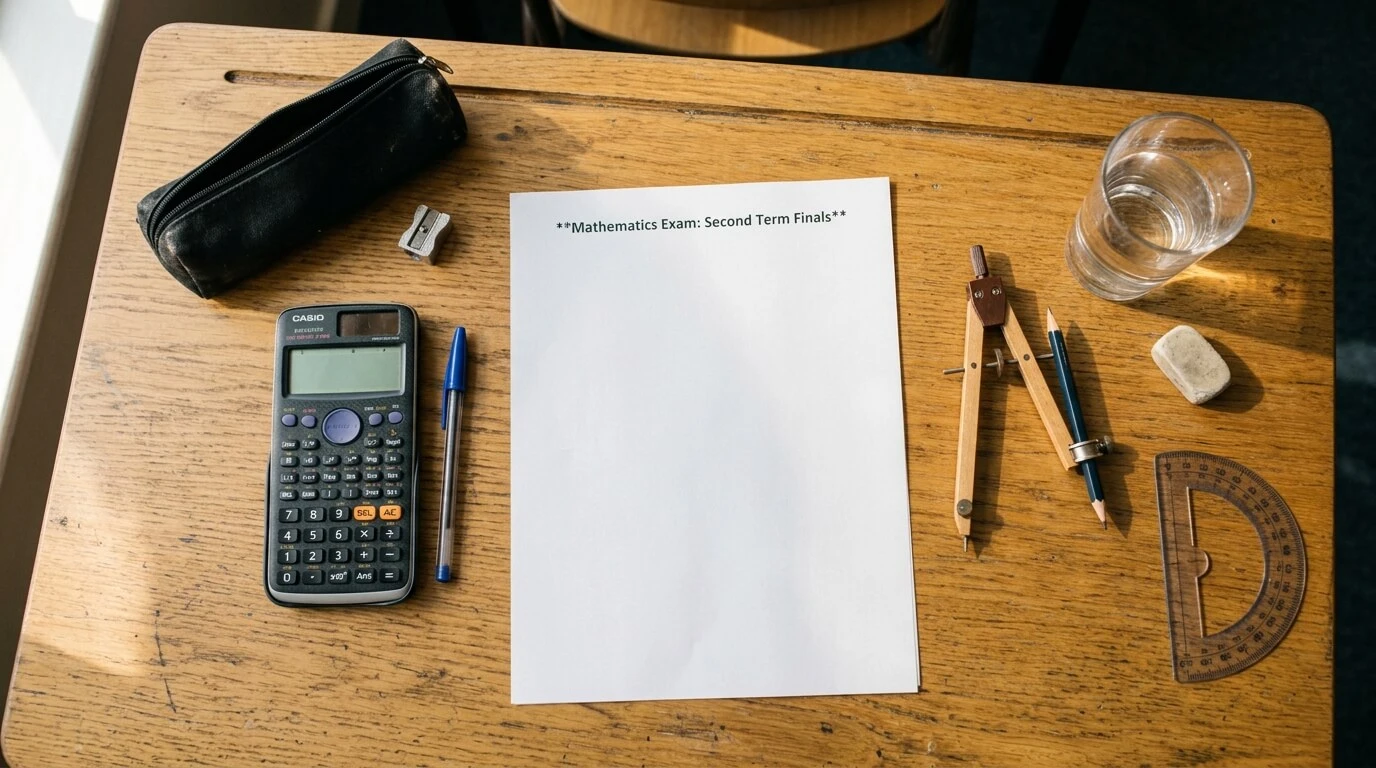
4. Important Topics to Revise
The exact topics will depend on your syllabus, but students commonly need to revise areas such as algebra, geometry, arithmetic, fractions, percentages, equations, ratios, statistics, and measurement.
Instead of trying to memorise everything at once, divide the syllabus into smaller sections.
Algebra
Practise simplifying expressions, solving equations, working with variables, and applying algebraic rules.
Geometry
Revise shapes, angles, properties, perimeter, area, and relevant theorems or formulas included in your syllabus.
Arithmetic
Review fractions, decimals, percentages, ratios, averages, and other numerical calculations.
Measurement
Practise questions involving length, area, volume, units, and conversions where these are part of your course.
Data and Statistics
If included in your syllabus, revise tables, graphs, averages, and interpretation of information.
The most important point is to follow your actual syllabus rather than assuming every second-term maths paper contains the same topics.
5. How to Prepare a Maths Study Plan
A study plan can turn a large syllabus into manageable pieces.
Start by making three lists:
- Topics I understand well
- Topics I partly understand
- Topics I find difficult
Begin with the difficult areas while you have enough time to ask questions and practise.
A simple daily routine might look like this:
First 20 minutes: Review formulas and important rules.
Next 30–40 minutes: Study one concept.
Next 30 minutes: Solve practice questions without looking at answers.
Final 10 minutes: Check mistakes and write down what went wrong.
You do not need to study mathematics for several hours without a break. Short, focused sessions are often easier to maintain.
Most importantly, don’t only solve questions that you already know. Your mistakes are useful information. They tell you exactly where more practice is needed.
6. Practising Different Types of Questions
One of the biggest preparation mistakes is solving the same type of question repeatedly.
Suppose you can easily solve basic percentage calculations. That is useful, but your exam might present a percentage problem as a word problem.
For example, instead of asking directly for 20% of a number, the question could describe a discount, increase, profit, or population change.
Therefore, practise questions with different wording.
Include:
- Easy questions for confidence.
- Medium questions for regular practice.
- Challenging questions for deeper understanding.
- Word problems for application.
- Mixed questions for examination practice.
After solving a question, ask yourself: “Why did I use this method?”
If you can explain the method, rather than merely copying the steps, you probably understand the concept much better.
7. Using Sample Papers Effectively
A sample or previous question paper can be one of the best revision tools available.
However, don’t immediately look at the answers.
Instead, recreate examination conditions. Put away your textbook, set a timer, and attempt the paper from beginning to end.
When finished, check your work carefully.
Create a simple mistake list:
| Mistake | Possible Reason |
|---|---|
| Wrong formula | Formula not revised |
| Calculation error | Worked too quickly |
| Wrong method | Concept needs review |
| Question misunderstood | Read too quickly |
| Unit missing | Final answer not checked |
This turns a practice paper into more than a test. It becomes a diagnostic tool showing you what to improve.
Try another paper after a few days and compare your performance.

8. Common Mistakes Students Should Avoid
Even students who understand mathematics can lose marks through avoidable errors.
Skipping Steps
Writing only the final answer can make it difficult to identify where a calculation went wrong. Unless your teacher specifically says otherwise, show important working.
Ignoring Units
In measurement questions, an answer without the correct unit may be incomplete.
Misreading Questions
A student may know the mathematics but answer the wrong thing because the question was read too quickly.
Rushing Calculations
Speed is useful, but accuracy matters more. A correct method with one careless arithmetic error can still lead to a wrong answer.
Not Checking Answers
Always reserve some time at the end to review your work.
Check signs, decimal points, units, formulas, and calculations. A two-minute check can sometimes recover marks that would otherwise be lost.
9. Time Management During the Exam
Good time management can make a major difference.
At the beginning, quickly look through the paper and understand how it is organised. Start with questions you can answer confidently, unless your examination instructions require a specific order.
If a question becomes difficult, don’t allow it to consume too much time.
A useful approach is:
- Read the complete question.
- Identify what information is given.
- Decide what needs to be found.
- Choose the appropriate method.
- Solve carefully.
- Check the answer when possible.
If you reach a difficult question, mark it and return to it later.
Remember: one difficult question should not steal the time needed to answer five easier questions.
10. How Parents and Teachers Can Help
Students often perform better when adults provide encouragement rather than unnecessary pressure.
Parents can help by providing a quiet study environment and encouraging a regular routine. Asking, “Which question was difficult today?” may be more helpful than simply asking, “How many marks did you get?”
Teachers can support students by providing practice questions, explaining common mistakes, and helping learners understand why a particular method works.
Students should also feel comfortable asking questions.
There is no shame in saying, “I don’t understand this step.” In fact, asking questions early can prevent confusion from growing later.
11. Final Revision Strategy
During the final days before the examination, avoid trying to learn the entire syllabus from the beginning.
Instead, concentrate on:
Important formulas: Write them down and practise using them.
Weak chapters: Spend extra time on topics where you repeatedly make mistakes.
Previous questions: Use them to become familiar with question styles.
Calculation practice: Work carefully but try to improve your speed.
Mistake review: Revisit questions you previously answered incorrectly.
On the night before the exam, get enough rest. Staying awake for hours while trying to memorise every formula can leave you tired and less focused the next day.
Prepare your stationery and other required materials in advance so you can enter the examination calmly.
12. Conclusion
Preparing for a second term maths question paper does not have to be overwhelming. The strongest approach is simple: understand the syllabus, practise regularly, learn from mistakes, and become familiar with different question styles.
You don’t need to solve hundreds of random questions every day. Focused practice is more valuable than endless practice. Start early, work steadily, and give extra attention to the topics that challenge you most.
FAQs
1. What should I study first for a second-term maths exam?
Start with the chapters included in your syllabus. Identify difficult topics first, then revise formulas and practise questions from each area.
2. How many practice papers should I solve?
There is no fixed number. Aim to solve enough papers to become comfortable with the format and identify repeated weaknesses. Quality and careful review matter more than quantity.
3. Should I memorise maths formulas?
You should know important formulas, but understanding how and when to use them is equally important. Practising questions helps make formulas easier to remember.
4. What should I do if I cannot solve a question?
Read it again, identify the information given, and determine what the question is asking. If you still cannot solve it, move on temporarily and return later.
5. How can I avoid losing marks in maths?
Read questions carefully, show your working, use the correct formula, check calculations, include units where required, and reserve time to review your answers.